
-
muhammadamjadbutt00@gmail.com
- March 1, 2026
- 0 Comments
- blog
Introduction:
3D printing, especially in construction, is no longer limited to factories or small plastic models. From your provided detail, the focus is on additive construction (AC) and its growing role in underwater and coastal infrastructure projects. This shows how 3D printing is moving directly into real-world environments, including marine conditions.
How 3D Printing Works in Construction
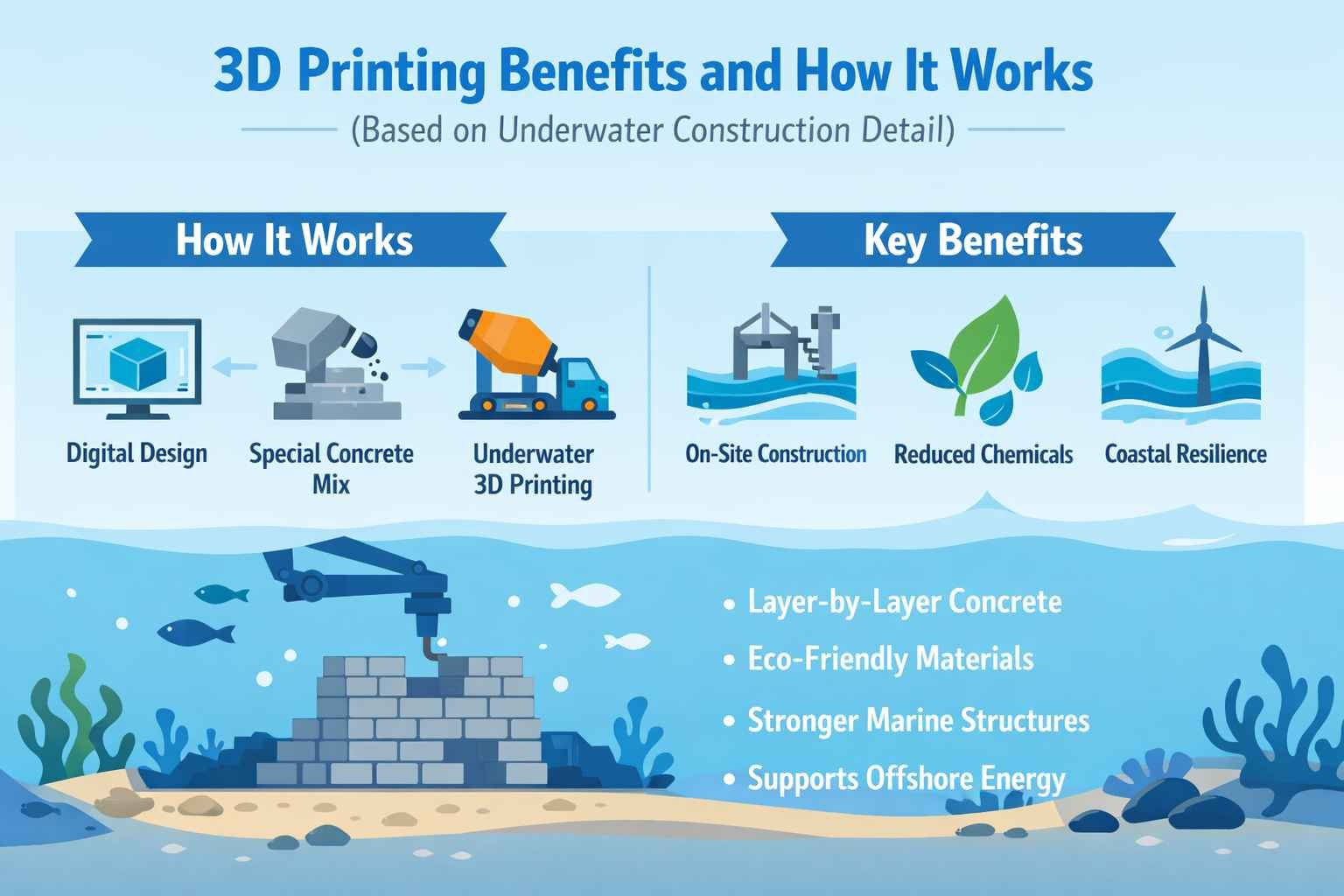
In additive construction, a large-scale robotic printer deposits concrete layer by layer to form structures. Instead of using traditional molds or heavy manual assembly, the machine follows a digital blueprint and builds the structure gradually.
For underwater or coastal projects, the process includes:
-
Digital Design Preparation – Engineers create a structural model suitable for marine conditions.
-
Material Engineering – A special concrete mix is developed to remain stable in saltwater.
-
Layer-by-Layer Deposition – The printer extrudes concrete underwater or in wet conditions without collapsing.
-
Material Stability Control – New formulas eliminate the need for chemical accelerators while maintaining strength.
Traditionally, accelerators are added to concrete to make it harden quickly and prevent washout underwater. However, new research has shown that carefully engineered mixes can stay intact without these chemicals, simplifying the process.
Key Benefits of 3D Printing in Underwater Infrastructure
1. Direct On-Site Printing
Instead of building parts off-site and transporting them, structures can now be printed directly underwater. This reduces logistics challenges and installation time.
2. Reduced Chemical Use
Removing concrete accelerators simplifies material handling and improves environmental sustainability in marine ecosystems.
3. Stronger Coastal Protection
3D printing supports coastal resilience by enabling customized barriers and restoration structures that match seabed conditions.
4. Sustainability
Using seabed sand, saltwater testing, and engineered material blends lowers dependency on complex additives and promotes eco-friendly construction.
5. Faster Infrastructure Development
Automated printing speeds up the building process for offshore wind energy foundations, marine repairs, and defense-related projects.
6. Simplified Construction Process
By eliminating unnecessary chemical steps, the printing method becomes easier to scale commercially.
Why This Development Is Important
The growing interest in underwater additive construction signals strong demand for marine infrastructure solutions. When 3D printing can operate directly in submerged conditions, it changes how governments and companies approach:
-
Coastal resilience projects
-
Offshore wind energy installations
-
Marine defense infrastructure
-
Ecological restoration efforts
If material science improvements continue, underwater 3D printing could move from laboratory testing to large-scale commercial deployment. This would shift additive manufacturing from a niche technology to a core part of public infrastructure development.
Final Thought
Based on your detail, 3D printing in underwater construction works by digitally controlled, layer-by-layer concrete deposition using specially engineered mixes that remain stable without accelerators. Its benefits include sustainability, simplified processes, faster deployment, and stronger marine infrastructure solutions.